
HVAC Solutions for Data Centers: Airflow, Filtration and Reliability
Data center HVAC systems must do far more than keep a room cool. Effective cooling depends on controlled airflow, appropriate filtration, environmental monitoring and reliable operation as IT loads change.
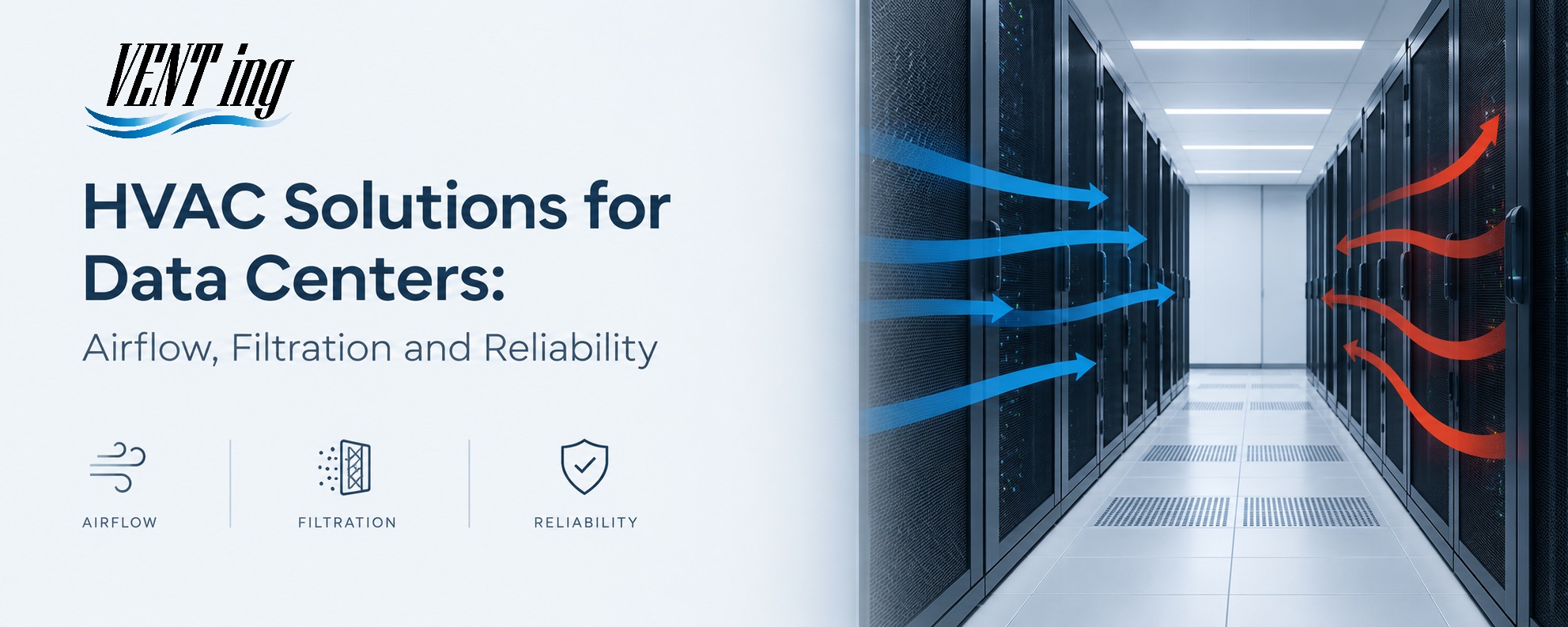
Servers, storage systems, networking equipment and other IT infrastructure continuously generate heat. If cooling is poorly matched to the equipment and the facility, thermal conditions can become uneven, energy use can rise and operational reliability can suffer.
A data center HVAC system therefore has to manage several connected requirements: airflow, heat removal, filtration, temperature, humidity and reliability. The right approach depends on the IT load, rack density, facility layout, climate, contamination risks and the operational requirements of the site.
The practical principle: data center cooling works best when airflow, filtration, environmental control, monitoring and reliability are designed as one system rather than as separate components.
Airflow Management: Keeping Supply and Return Air Separate
Airflow management is fundamental to effective data center cooling. Conditioned supply air should reach the air inlets of IT equipment, while hot exhaust air should return to the cooling equipment without unnecessary mixing.
Uncontrolled mixing, including bypass and recirculation airflow, can reduce cooling effectiveness and contribute to uneven temperatures within the data hall. A common strategy is the hot-aisle/cold-aisle arrangement, where rack fronts face one another to form cold aisles and rack rears face one another to form hot aisles.
Practical airflow measures
- Use blanking panels in unused rack spaces.
- Seal openings around cable penetrations.
- Place perforated or vented floor tiles where supply air is actually required.
- Minimize obstructions in supply-air paths.
- Consider hot-aisle or cold-aisle containment.
- Use in-row or in-rack cooling where higher-density applications require it.
In raised-floor facilities, underfloor pressure, supply-plenum dimensions, tile location and airflow distribution should also be considered. Airflow assessments can help identify areas where cooling capacity is not reaching the IT load effectively.
Containment can further limit interaction between hot exhaust and cold supply air. Computational fluid dynamics (CFD) can be used to model airflow and temperature distribution, while thermal imaging can help identify hot and cold spots in an operating facility.
Filtration: Protecting IT Equipment From Contaminants
Cooling air needs to be clean enough to protect sensitive electronic equipment. Dust and other airborne contaminants can accumulate inside IT equipment and, depending on the contaminant and environmental conditions, contribute to reliability problems.
Filtration should therefore be considered as part of the overall data center environmental strategy. The appropriate approach depends on the equipment, outdoor environment and applicable design requirements. Both particulate contamination and gaseous pollutants can matter, particularly where corrosive contaminants are present.
Filters also introduce pressure drop into an air stream. Filter selection, fan capacity, maintenance and monitoring therefore need to be considered together. In locations exposed to significant outdoor pollution or corrosive contaminants, particulate filtration alone may not address every environmental risk.
Temperature and Humidity Control
Maintaining appropriate temperature and humidity is another core responsibility of a data center HVAC system. Operating conditions should be selected according to the applicable environmental envelope for the IT equipment and the requirements of the facility rather than simply targeting the lowest possible room temperature.
Rack-inlet temperature sensors can provide more useful information about actual IT equipment conditions than relying exclusively on a single room-level measurement. Monitoring temperature, inlet temperatures, airflow and power can help operators match cooling capacity more closely to actual IT loads.
This becomes especially useful when IT loads change significantly during the day or when high-density equipment is introduced.
Reliability: HVAC Must Support Continuous Operation
For mission-critical facilities, cooling reliability is closely tied to overall data center reliability. HVAC design should reflect expected IT loads, maintenance requirements, environmental conditions and the consequences of equipment failure.
Redundancy is one part of a reliable design, but it is not the whole solution. Controls, sensors, power supplies, pumps, fans, chillers, heat-rejection equipment and other components all influence how the cooling system behaves when individual components require maintenance or become unavailable.
Monitoring and maintenance matter too
Modern control systems can use temperature, airflow and load information to adjust cooling capacity according to actual conditions. Regular inspection and maintenance are equally important. Filters, fans, coils, pumps, dampers, sensors and controls need to continue performing as designed.
A correctly designed cooling system can still lose performance over time if airflow components, filters, sensors and controls are not properly maintained.
Cooling Efficiency Without Compromising Reliability
Cooling can represent a substantial share of data center energy consumption, which makes HVAC optimization an important efficiency opportunity. The first step is often to eliminate unnecessary airflow losses and uncontrolled mixing. Once airflow is properly managed, controls can be optimized to match cooling capacity to the actual IT load.
Depending on the facility and climate, other technologies may also be appropriate. These can include air-side or water-side economization, in-row cooling, in-rack cooling and liquid-cooling technologies for sufficiently high-density applications.
The right technology depends on the IT equipment, building design, climate and operational requirements. Liquid and liquid-assisted cooling are options for high-density equipment, while air cooling remains important for many conventional IT environments.
Designing HVAC Around the Data Center
There is no single HVAC configuration that is optimal for every data center. The cooling strategy should begin with an understanding of the actual and anticipated IT heat load rather than treating the data hall as a conventional conditioned space.
| Design factor | Why it matters |
|---|---|
| IT equipment and rack density | Determines heat load and the required cooling approach. |
| Facility size and layout | Influences airflow distribution and equipment placement. |
| Outdoor climate | Affects cooling strategy and potential efficiency measures. |
| Contamination risks | Helps determine filtration and environmental protection needs. |
| Availability and redundancy | Shapes the system’s ability to support continuous operation. |
| Future expansion | Helps ensure the HVAC strategy can adapt to changing IT loads. |
| Energy-efficiency objectives | Guides airflow optimization, controls and technology selection. |
Airflow modeling, appropriate filtration, rack-level temperature monitoring and properly configured controls can provide a more precise approach to cooling management than simply increasing the number or capacity of cooling units.
Frequently Asked Questions
Why is airflow management important in a data center?
What does filtration do in a data center HVAC system?
How should temperature be monitored in a data center?
Does redundancy alone make a data center HVAC system reliable?
Can data center cooling be made more energy efficient?
Reliable data center HVAC starts with the actual IT load, airflow requirements and operational goals of the facility.
Explore Venting HVAC solutions →